

Lightspeed Restoration of Greater West Austin
Case Studies
Hidden Mold Behind a Bathroom Vanity in Liberty Hill, TX
Residential mold remediation
Hidden Mold Behind a Bathroom Vanity in Liberty Hill, TX
Location: Liberty Hill, Texas
Service: Residential mold remediation
A clean bathroom can still have something hiding behind the vanity.
At this Liberty Hill home, the bathroom looked ordinary from the outside. But a hidden water leak behind the cabinet had created a mold problem that wasn’t obvious from the finished surfaces.
Lightspeed Restoration of Greater West Austin helped address the affected area and document what was happening behind the scenes.
The Problem: A Hidden Leak Behind the Cabinet
Most homeowners wouldn’t look at this bathroom and suspect mold. The vanity and surrounding finishes concealed the affected materials, leaving little indication of what was happening behind them.
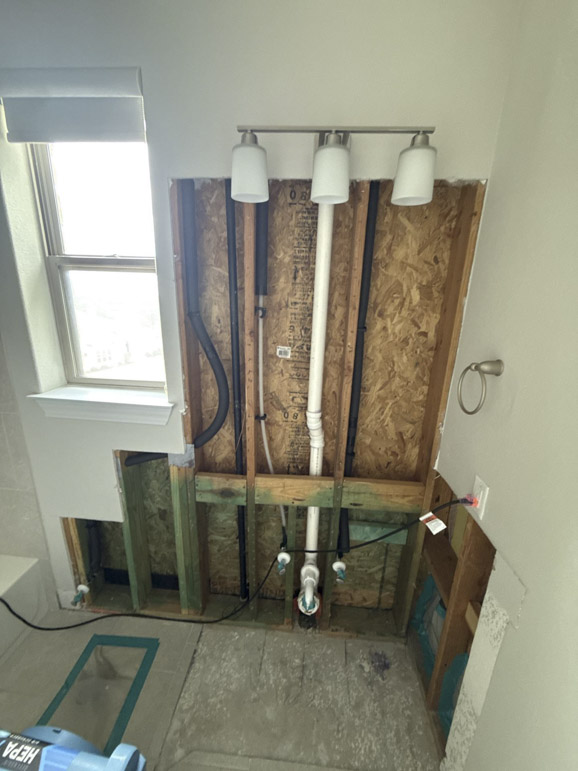
A licensed mold assessor confirmed mold through testing. The project photos show the difference between the bathroom’s everyday appearance and the conditions uncovered behind the vanity.
It’s a reminder that a room can look clean while moisture is causing damage out of sight.
Our Work: Containing the Affected Area
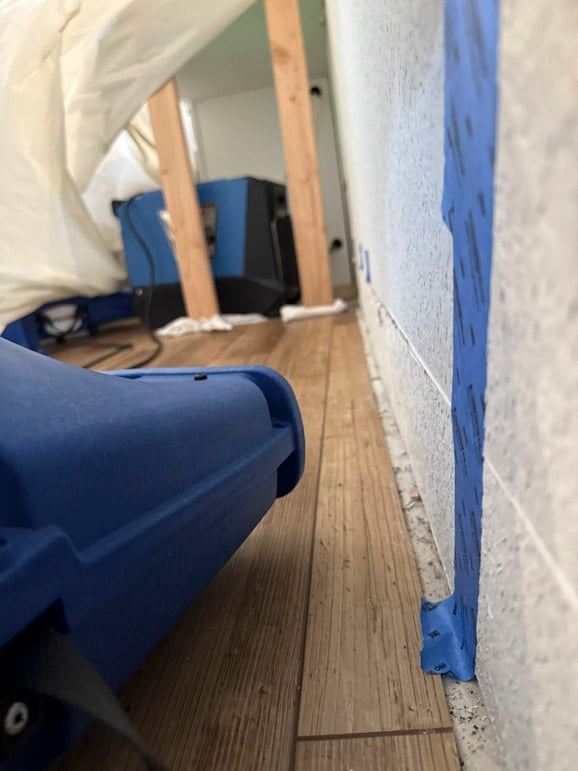
Our team performed mold remediation and installed containment to separate the bathroom work area from the surrounding living space. The protective barrier helped limit the spread of dust and disturbed material during the work.
The photos document the concealed damage, the exposed wall cavity, and the containment installed during remediation. They give homeowners a clearer picture of why addressing hidden mold involves more than wiping down a visible surface.
The Takeaway: Looking Clean Doesn’t Tell the Whole Story
If you’ve had a leak under a sink or behind a cabinet, the bathroom’s appearance alone won’t tell you whether hidden materials were affected.
Lingering odors, swollen cabinetry, damaged baseboards, or a history of leaking plumbing are reasons to take a closer look. Identifying the moisture source and addressing the affected materials are important parts of resolving the problem.
Local Help With Mold in Liberty Hill
Lightspeed Restoration of Greater West Austin is a Texas-licensed mold remediation company based right here in Liberty Hill. We’re woman-owned, first responder-owned, and guided by Christian values.
We know an unexpected mold problem can feel overwhelming. We’ll explain the work, provide a clear estimate, and talk through your options with your budget in mind.
Concerned about mold behind a bathroom vanity or damage from a hidden leak? Give us a call to discuss your next steps.
Neighbors Helping Neighbors.
The Dishwasher Leak That Took the Scenic Route
The Dishwasher Leak That Took the Scenic Route
Quick action helped a Leander homeowner avoid a much bigger—and potentially moldier—problem.
A disconnected dishwasher supply line may sound like a small plumbing problem. Unfortunately, water rarely respects property lines, room labels, or your renovation budget.
When the supply line disconnected in this Leander, Texas home, water escaped behind the dishwasher and traveled into the adjoining cabinet. From there, it followed the wall and baseboard into the dining room.
The homeowner knew there had been a leak. What he did not know was how far the water had traveled because most of the affected areas looked perfectly normal from the outside.
That is where moisture meters—not guesswork—made the difference.
The Plot Twist: The Water Wasn’t Just in the Kitchen
At first glance, the problem appeared to be concentrated around the dishwasher. Our moisture inspection told a different story.
Using professional moisture-detection equipment, the Lightspeed Restoration of Greater West Austin team traced elevated moisture from behind the dishwasher into the neighboring cabinet, wall materials, baseboard, and dining area.
Affected materials included:
- Drywall
- Wood sill plates
- Particleboard cabinetry
- Laminate flooring
- Baseboard and shoe molding
One hidden drywall location registered at the maximum reading on the meter’s relative scale. Without professional moisture mapping, the homeowner would have had no reason to suspect that water had traveled that far.
In other words, the visible leak was only part of the story. The moisture meter found the unauthorized sequel.
Our Water-Mitigation Plan
Because the homeowner acted quickly, the water was still classified as a Category 1 water loss, and the affected area could be addressed with a relatively limited mitigation scope.
Our team:
- Detached the dishwasher to access the source area
- Carefully detached and supported a portion of the lower cabinetry
- Removed a small amount of wet drywall
- Removed affected baseboard and shoe molding
- Established a controlled work area
- Used HEPA-filtered air filtration during demolition
- HEPA-vacuumed and cleaned the affected surfaces
- Applied an antimicrobial treatment to the appropriate surfaces
- Installed an LGR dehumidifier and low-profile air movers
- Monitored moisture levels throughout the drying process
We began with two air movers and reduced the equipment as materials responded to drying. This allowed us to use only the equipment the property needed rather than leaving unnecessary machines running.
Documented Drying—Not “It Feels Dry to Me”
Our technicians returned to document moisture levels and drying conditions. Initial readings confirmed elevated moisture in the drywall, sill plates, cabinetry, and flooring.
Over the following three days, the readings steadily declined. By April 24, the monitored materials had reached their established drying goals.
This documentation gave the homeowner more than a room that appeared dry. It provided measurable evidence that the affected materials were dry.
A Small Job That Could Have Become a Large One
This was not an expensive water-mitigation project—and that is part of what makes it a success story.
The homeowner acted quickly. That allowed us to locate the hidden moisture, remove only the materials that could not be appropriately dried, and begin structural drying before the damage became more extensive.
If the moisture had remained trapped behind the dishwasher, cabinet, drywall, and baseboard, it could have created conditions that support mold growth and further material deterioration. That could have changed a relatively small mitigation project into a more disruptive and expensive mold-remediation and reconstruction project.
Catching water early does not just help dry the house faster. It can protect the homeowner’s future repair budget.
The Takeaway
Water damage is not limited to the puddle you can see.
Water can travel underneath flooring, behind cabinets, through wall cavities, and along baseboards without leaving an obvious surface stain. After a dishwasher leak, refrigerator-line leak, sink overflow, or other appliance failure, professional moisture detection can help determine how far the water actually traveled.
Sometimes the best restoration story is the expensive disaster that never got the chance to happen.
Frequently Asked Questions
Can water from a dishwasher leak travel into another room?
Yes. Water can move beneath appliances, cabinets, flooring, and baseboards. Depending on the home’s materials and layout, moisture may travel into an adjoining room without producing an immediately visible stain or puddle.
Can drywall or framing be wet without looking wet?
Absolutely. Paint, trim, cabinetry, and flooring can conceal elevated moisture. Professional moisture meters allow restoration technicians to evaluate materials that may look and feel dry on the surface.
Does every dishwasher leak require extensive demolition?
No. The necessary scope depends on the amount of water, how far it traveled, how long materials remained wet, and whether those materials can be dried safely. Quick action may substantially reduce the amount of demolition and reconstruction required.
Can a small water leak eventually lead to mold?
Moisture that remains trapped inside building materials can create conditions that support mold growth. Temperature, humidity, materials, and drying time all affect the risk, which is why prompt moisture detection and professional drying are important.
What should I do after discovering an appliance leak?
Stop the water source if it is safe to do so, avoid using affected electrical fixtures or appliances, and contact a qualified water-mitigation company. Even when the visible water has been cleaned up, hidden materials may still be wet.
Concerned About Hidden Water Damage?
If you have experienced a dishwasher leak, plumbing leak, appliance-line failure, or unexplained water stain, Lightspeed Restoration of Greater West Austin can inspect the affected area and determine whether hidden moisture is present.
We provide professional water-damage mitigation and structural drying services in Leander, Liberty Hill, Cedar Park, Austin, and surrounding Greater West Austin communities.
Because when water takes the scenic route, it helps to have someone who knows how to track it.
Lightspeed Restoration of Greater West Austin
Neighbors Helping Neighbors
Emergency Roof Leak & Water Damage in Austin, TX
When a Can Light Becomes a Water Feature
An Austin homeowner arrived home from work around 6:00 p.m. on a Friday to find water pouring through a recessed can light in her kitchen ceiling.
A roof leak had allowed water to travel through the attic, wetting insulation, framing, and ceiling materials before finding an exit through the light fixture.
Can lights are great for illumination. They are much less impressive as indoor waterfalls.
Lightspeed Restoration of Greater West Austin responded to assess the damage, complete the water mitigation, and later reconstruct the affected ceiling.
Protecting the Kitchen
Because the water entered above an active kitchen, protecting the cabinets, countertops, appliances, and surrounding contents was essential.
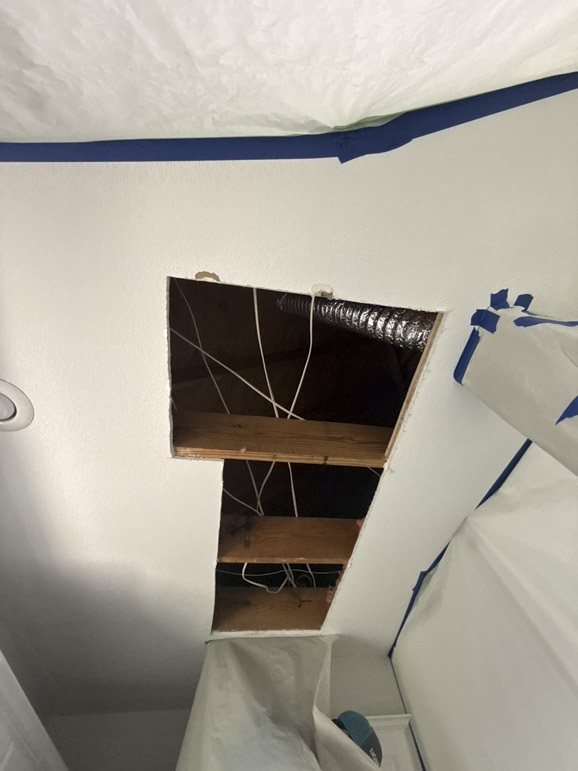
Our technicians built specialized containment with plastic sheeting before opening the ceiling. This helped keep insulation, drywall dust, and demolition debris from spreading into unaffected areas.
We then inspected the kitchen and attic with professional moisture-detection equipment to determine how far the water had traveled.
Water Mitigation and Structural Drying
Our mitigation work included:
- Removing approximately 13 square feet of wet ceiling drywall
- Removing affected blown-in attic insulation
- HEPA-vacuuming and cleaning the work area
- Treating appropriate surfaces
- Installing an LGR dehumidifier
- Directing air movers across the ceiling and framing
- Placing targeted airflow in the attic
- Monitoring moisture levels until drying goals were reached
Kitchen drying equipment operated for approximately 48 hours, while the attic received targeted airflow for approximately 24 hours.
The structure was not declared dry because it looked or felt better. Moisture readings documented the progress. One monitored attic material decreased from a relative reading of 22.8 to 6.2 before the equipment was removed.
Reconstruction: Putting the Home Back Together
Drying the structure solved the moisture problem, but the homeowners still needed their kitchen ceiling restored.
Lightspeed Restoration also coordinated the reconstruction, including:
- Replacing the removed insulation and ceiling drywall
- Taping and finishing the drywall
- Matching the existing knockdown texture
- Priming and painting the repaired ceiling
- Painting adjoining ceiling areas for a consistent finish
- Resetting HVAC registers and recessed-light trim
- Completing final construction cleaning
By handling both the water mitigation and reconstruction, we helped take the project from Friday-night emergency to completed repairs with one restoration team.
The Result
The affected attic and kitchen materials were professionally dried, the damaged ceiling was reconstructed, and the finishes were blended back into the home.
The homeowners were left with a restored kitchen—and one fewer unexpected water feature.
What Should You Do If Water Is Coming Through a Ceiling Light?
Do not touch the fixture or stand beneath it. Water around electrical wiring may create a shock or fire hazard. Turn off power to the affected area only if you can do so safely, keep people and pets away, and contact qualified professionals.
Remember: the visible drip shows where the water came out. It does not necessarily show everywhere the water went.
Frequently Asked Questions
Does ceiling drywall always need to be removed after a roof leak?
Not always. The decision depends on the amount of water, the condition of the drywall and insulation, and whether the materials can be dried safely.
How long does structural drying take?
Drying time varies by project. In this Austin home, targeted drying equipment operated for approximately two days, with moisture readings taken throughout the process.
Can one company handle mitigation and repairs?
Yes. Lightspeed Restoration of Greater West Austin provides water mitigation, structural drying, selective demolition, and reconstruction services.
Need Water-Damage Restoration in Austin?
Lightspeed Restoration of Greater West Austin provides emergency water mitigation and reconstruction services throughout Austin, Liberty Hill, Leander, Cedar Park, Bee Cave, Lakeway, and surrounding communities.
Neighbors Helping Neighbors—and taking the surprise water features out of Texas homes.
Mold In Main House
A customer in Arlington, VA called in to say he had visible mold growth in his kitchen, dining and living room areas. Concerned about his family's health, he asked us to come out for a free mold inspection and estimate.
Location: Arlington, VA 22201
Problem: A customer in Arlington, VA called in to say he had visible mold growth in his kitchen, dining and living room areas. Concerned about his family's health, he asked us to come out for a free mold inspection and estimate.
Solution: Using a containment system, we sealed off the affected areas so we wouldn't contaminate the rest of the home. We remediated the mold, HEPA vacuumed the surfaces and used an antimicrobial solution to wipe down the walls and floors. When our team was finished, the customer's home was a safer and healthier environment.


Sewage Situation In Clinic
This clinic had a drain pipe rupture from the unit above. Sewage spilled into the clinic by the utility room, laundry room and staff break room. The carpet outside these rooms was contaminated and the walls were wet.
Location: Bee Cave, TX 78738
Problem: This clinic had a drain pipe rupture from the unit above. Sewage spilled into the clinic by the utility room, laundry room and staff break room. The carpet outside these rooms was contaminated and the walls were wet.
Solution: The customer did not want to remove the carpet so we cleaned it with steam and a professional cleaning solution. We opened up the walls to sanitize them completely and to remove the wet insulation. When we started, there was a distinct odor of urine. Once our mitigation and drying efforts were completed, the odor was gone and the structure was clean and dry.


Apartment Air Testing & Air Duct Cleaning
A property management company needed a service provider to perform indoor air quality testing in apartment complexes. Tenant air quality complaints become big concerns for property manager.
Location: Cedar Park, TX 78613
Problem: A property management company needed a service provider to perform indoor air quality testing in apartment complexes. Tenant air quality complaints become big concerns for property manager. Air testing can either squelch the complaint or validate it, which lets the the property manager know they have remediation or corrective steps to take. Air duct cleaning needed to be performed due to tons of mold and debris stuck in the air duct system.
Solution: Lightspeed Restoration provided next day air testing and offered air duct cleaning at a discount rate. This was apart of a multi-layered apartment partnership plan that included dryer vent and air duct/coil cleaning periodically for all tenants. In picture provided, you can see how much mold was found in the apartment. This location was going through major renovations and the property manager was able to use this information against the contractor because the cleaning and HVAC work wasn't up to par with health standards. Air duct cleaning is a crucial part of healthy indoor air quality. We performed air duct cleaning and mold removal for this local apartment complex and the tenants and property management company was very pleased.
